

Sustainability has become one of the key differentiating factors in the hospitality industry. More and more hotels are integrating environmental strategies that include decarbonization, energy efficiency, circular economy practices, and responsible resource management.
In this context, digital buffet labeling is gaining importance as a technological solution that helps reduce waste and improve operational efficiency in the F&B area.
Hotels such as Bucuti & Tara Beach Resort, recognized as one of the most sustainable hotels in the world, or the Sani/Ikos group, highlighted for its commitment to sustainable hospitality, demonstrate how sustainability can be integrated across all levels of hotel operations.
However, beyond large-scale strategies, the real impact appears when these policies translate into daily hotel operations. And within those operations, the buffet plays a more important role than many people realize.
Sustainability in hotel buffets: an operational challenge
Buffets are one of the most active areas within a hotel’s F&B operation. Each service involves numerous repetitive processes: replenishing dishes, managing allergens, updating food information, and handling buffet signage.
In many hotels, buffet label management is still manual. This means printing new labels every day, laminating them for buffet use, and replacing them constantly during service.
This process leads to continuous consumption of paper, ink, and plastic, while also requiring time from kitchen or service teams to perform tasks that do not directly enhance the guest experience.
Although it may seem like a small detail, when repeated across all buffet stations and services, the cumulative impact becomes significant.
For this reason, more and more hotels are exploring technological solutions that allow them to make their buffets more sustainable and efficient.
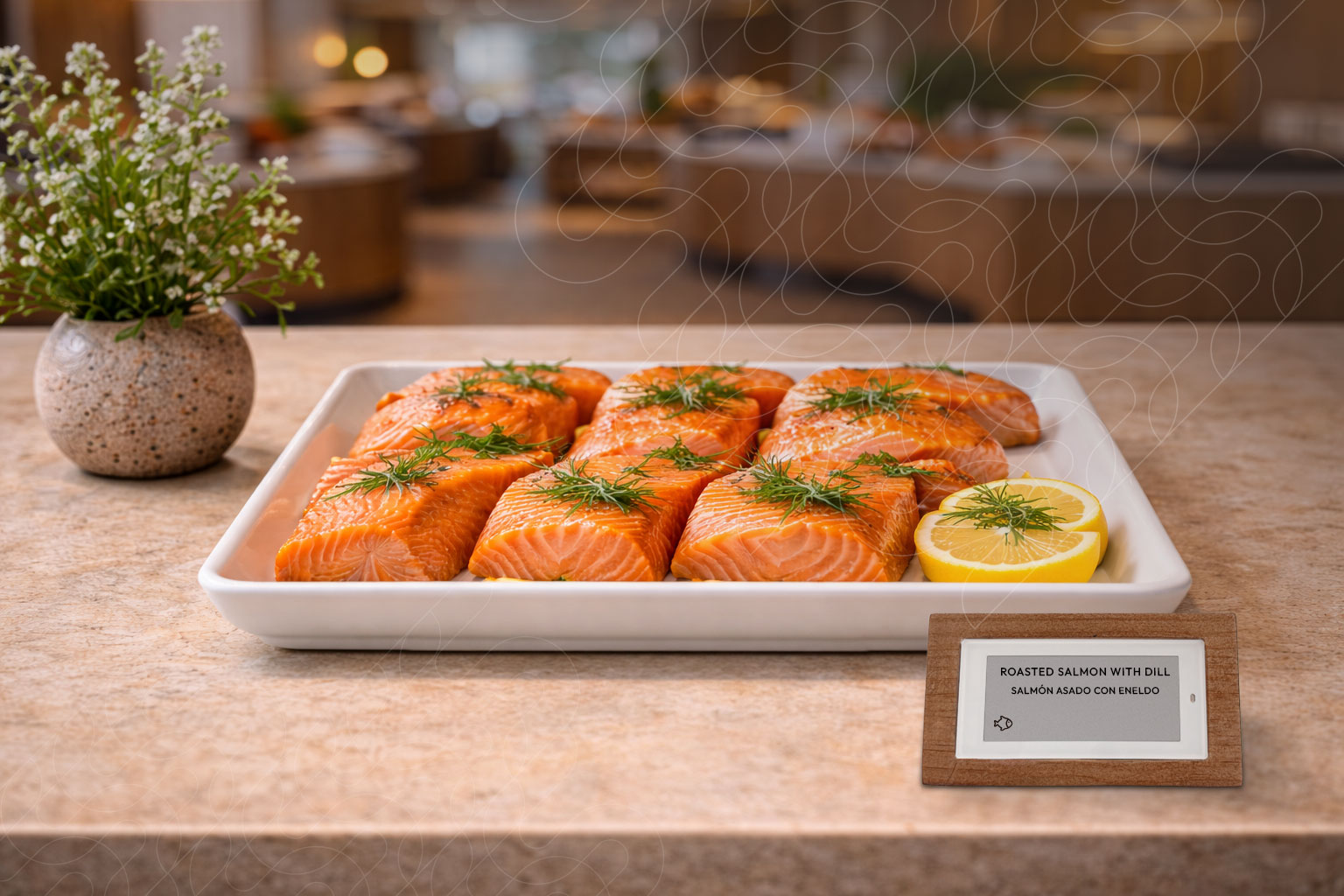
What is digital buffet labeling?
Digital buffet labeling is a system that displays dish information using electronic labels managed from a centralized platform.
From this system, buffet information can be updated in seconds: dish names, ingredients, allergens, languages, or menu changes.
This eliminates the need to print signage for every service and allows hotels to manage food information much more efficiently.
Advantages of digital labeling in hotel buffets
Waste reduction
Digitalization eliminates the constant cycle of printing and laminating labels. This significantly reduces the consumption of paper, ink, and single-use plastics.
Optimizing team workflow
Information updates can be made in seconds through the system, eliminating repetitive manual tasks and allowing the team to focus more on the guest experience.
Greater accuracy in allergen management
Centralizing dish information helps reduce errors in communicating ingredients and allergens, improving food safety.
Innovation in buffets: sustainability and operational efficiency
Many sustainability initiatives in hotels do not rely solely on large investments in infrastructure or energy. In many cases, the greatest impact comes from optimizing everyday operational processes.
Digitalizing buffet management is a good example. It not only reduces waste but also improves hotel operational efficiency.
This allows hotels to:
• reduce manual tasks
• improve buffet operational control
• optimize food information management
• offer a clearer and safer guest experience
In this context, sustainability also becomes a tool for operational efficiency.
Sustainable buffets: a growing trend in hospitality
As hotels advance their ESG strategies, more and more operational areas are being reviewed through a sustainability lens.
The buffet, traditionally considered a purely operational space, is beginning to play a role in this transformation.
Digitalizing label management, reducing waste, and simplifying processes are small changes that, when repeated daily, can generate a significant impact.
Sustainability is also built at the buffet
Sustainable transformation in hospitality is not achieved only through large projects. It is also built through operational decisions that improve efficiency and reduce environmental impact.
Digitalizing buffet management is one of them.
In addition to optimizing resources and simplifying team operations, digital buffet labeling contributes to more efficient management and a clearer guest experience.
Ultimately, sustainability in hospitality is reflected not only in large strategies but also in the everyday processes that keep hotels running.
Frequently asked questions about digital buffet labeling
What is digital buffet labeling?
It is a system that displays dish information using electronic labels connected to centralized software, eliminating the need to print new labels for every service.
How does digital labeling help buffet sustainability?
It reduces the consumption of paper, ink, and plastic associated with constantly printing labels, helping to reduce waste and improve operational efficiency.
Why are hotels digitalizing their buffets?
Because it simplifies operational processes, improves allergen management, reduces manual tasks, and supports more sustainable buffet operations.