
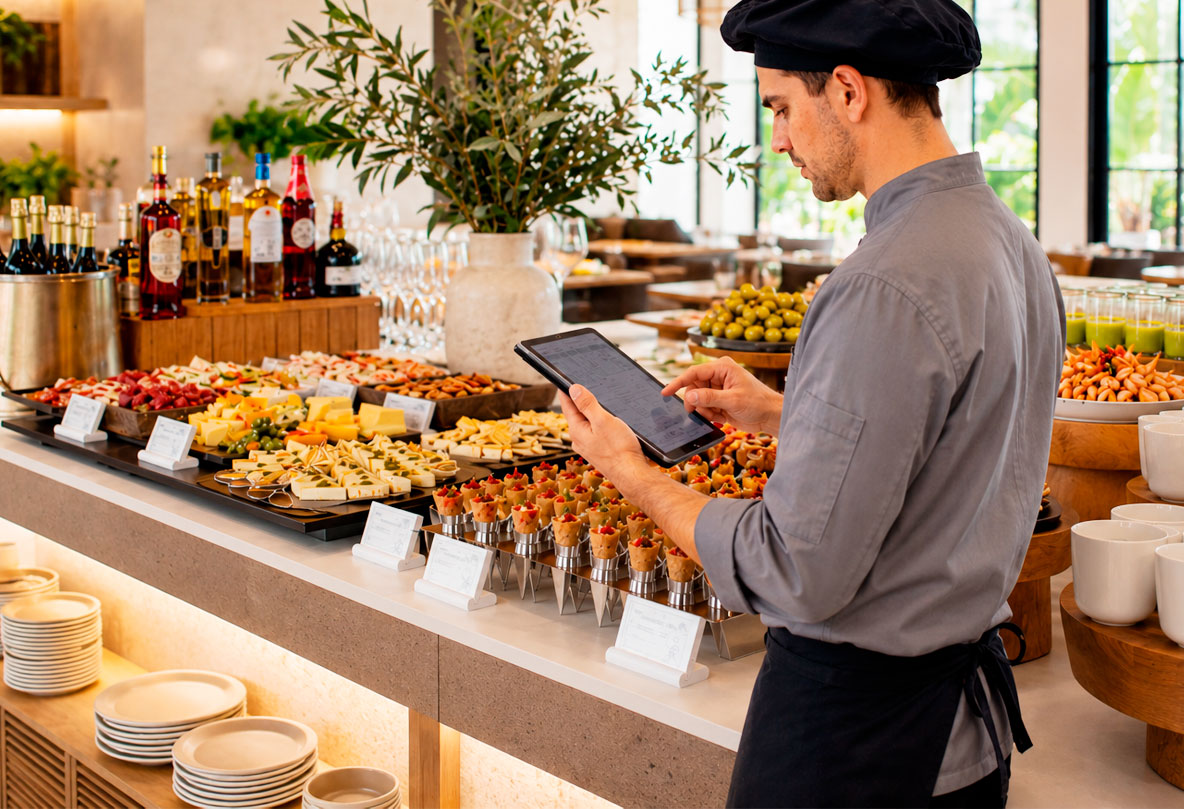
More and more hotel chains are investing in digital buffet labelling. However, not every project succeeds. We analyse why some implementations fail and what hotels should consider to successfully digitalise their buffet operations.
What is digital buffet labelling and why does it matter?
Digital buffet labelling is a system based on electronic labels connected to a centralised software platform that allows hotels to display, update and translate dish information in real time: names, ingredients, allergens, nutritional values and guest languages.
Unlike traditional paper signage, digital labels can be updated instantly from a single control panel. This means fewer errors, fewer manual tasks and improved food safety in one of the hotel’s most sensitive operational areas: the buffet.
However, the reality of the sector reveals something paradoxical: some hotels that invested in this technology eventually returned to paper.
Why we’re talking about this
In recent months, at Sincroni we have spoken with several hotels that had already tested digital labelling systems from other providers and later decided to return to manual signage. When we asked what had gone wrong, the answers were strikingly consistent.
This article brings together those lessons with one clear objective: to help any hotel considering buffet digitalisation make a well-informed decision.
The 5 most common mistakes when implementing digital buffet labelling in hotels
1. Choosing based on price instead of reliability
This is the most common mistake. In the short term, a low price may seem attractive. In the medium term, it often results in unreliable hardware, unstable software or lack of support when it is needed most.
Digital labelling is a long-term investment, not a one-off purchase. Reliability, software stability and continuous innovation from the provider are the factors that truly determine return on investment.
2. Failing to plan the placement of labels
The placement of labels within the buffet is strategic. When labels are installed without analysing the buffet operation first, staff often end up moving them manually between services, wasting time and increasing the risk of mistakes.
An initial planning phase that considers dish rotation, buffet stations and service dynamics helps automate processes and reduce operational strain on the F&B team.
3. Focusing on hardware and forgetting about software
Many projects are chosen based solely on the device itself: screen size, resolution or battery life. But software is the real core of the system. It enables menu updates, allergen management, dish translations and automated changes within seconds.
Before making a decision, hotels should test the management platform: Is it intuitive? Is it stable? Does it support multiple languages? Can it scale across multiple properties? Excellent hardware combined with poor software simply doesn’t work.
4. Not having real technical support after installation
Technology requires ongoing support. One of the most critical mistakes is underestimating post-installation assistance: updates, troubleshooting, training and maintenance.
A provider that disappears after delivering the equipment leaves the hotel without a safety net. When something fails during service, that absence quickly becomes a serious operational issue.
5. Not involving the F&B team from the beginning
The success of any digital system depends on the people using it. When the F&B team only learns about the change on the day the labels arrive, resistance, mistakes and underuse of the system’s capabilities are almost inevitable.
Involving operational teams from the diagnostic phase ensures smoother adoption and maximises the real value of the solution.
What successful digitalisation projects have in common
After analysing dozens of implementations, successful projects consistently share five characteristics:
- A prior operational diagnosis of the buffet before selecting technology.
- A tailored design that respects the hotel’s aesthetics and identity.
- Innovation with purpose: artificial intelligence, automation and continuous improvement that enhance both efficiency and guest experience.
- Real support during and after installation.
- Staff training as part of the project, not as an optional extra.
In every successful case, there is one common denominator: digitalisation is not treated as a technology purchase, but as an operational transformation supported every step of the way.
How to choose the right digital buffet labelling provider for hotels
If your hotel is considering taking the next step, these are the key questions you should ask any provider before making a decision:
- How long has the company specialised in the hotel sector?
- Can you see real case studies from similar hotel chains?
- What does the implementation and training process look like?
- What technical support is provided after installation?
- Is the software proprietary or outsourced?
- Does the system support international scalability?
- Can the labels and supports be adapted to the buffet’s aesthetics?
The answers to these questions are what separate a technology supplier from a true strategic partner.
Conclusion: digitalising the buffet is about transforming operations, not replacing paper with screens
Digital labelling can have a huge impact when implemented correctly. When implemented poorly, it creates frustration, hidden costs and, in some cases, a return to manual systems.
At Sincroni, we designed BuffetSmart around this principle: digitalisation is not about installing technology, but about supporting hotels through a deeper operational transformation. That’s why every project is tailored individually, with a strong focus on stability, scalability and ongoing support.
Whether your hotel has already experienced a failed implementation or is considering digitalisation for the first time, we can help you do it properly from the start.
Frequently asked questions about digital buffet labelling in hotels
Why do some hotels return to paper after digitalising their buffet?
Mainly for five reasons: choosing providers based on price rather than reliability, failing to plan label placement, focusing only on hardware, lacking technical support after installation and not involving the F&B team from the beginning.
How long does it take to recover the investment in a digital labelling system?
In most hotels, the initial investment is recovered within the first year thanks to time savings, the elimination of constant printing, reduced errors and improved operational stability.
Is the system difficult for the F&B team to use?
A well-designed digital labelling system is managed through an intuitive platform accessible from a mobile device or tablet. With proper training, teams usually adopt it naturally from the very first days.
Can digital labels be adapted to the buffet’s aesthetics?
Yes. In well-designed projects, the supports are customised to match the hotel’s décor and visual identity. Technology should integrate seamlessly, not feel intrusive.