
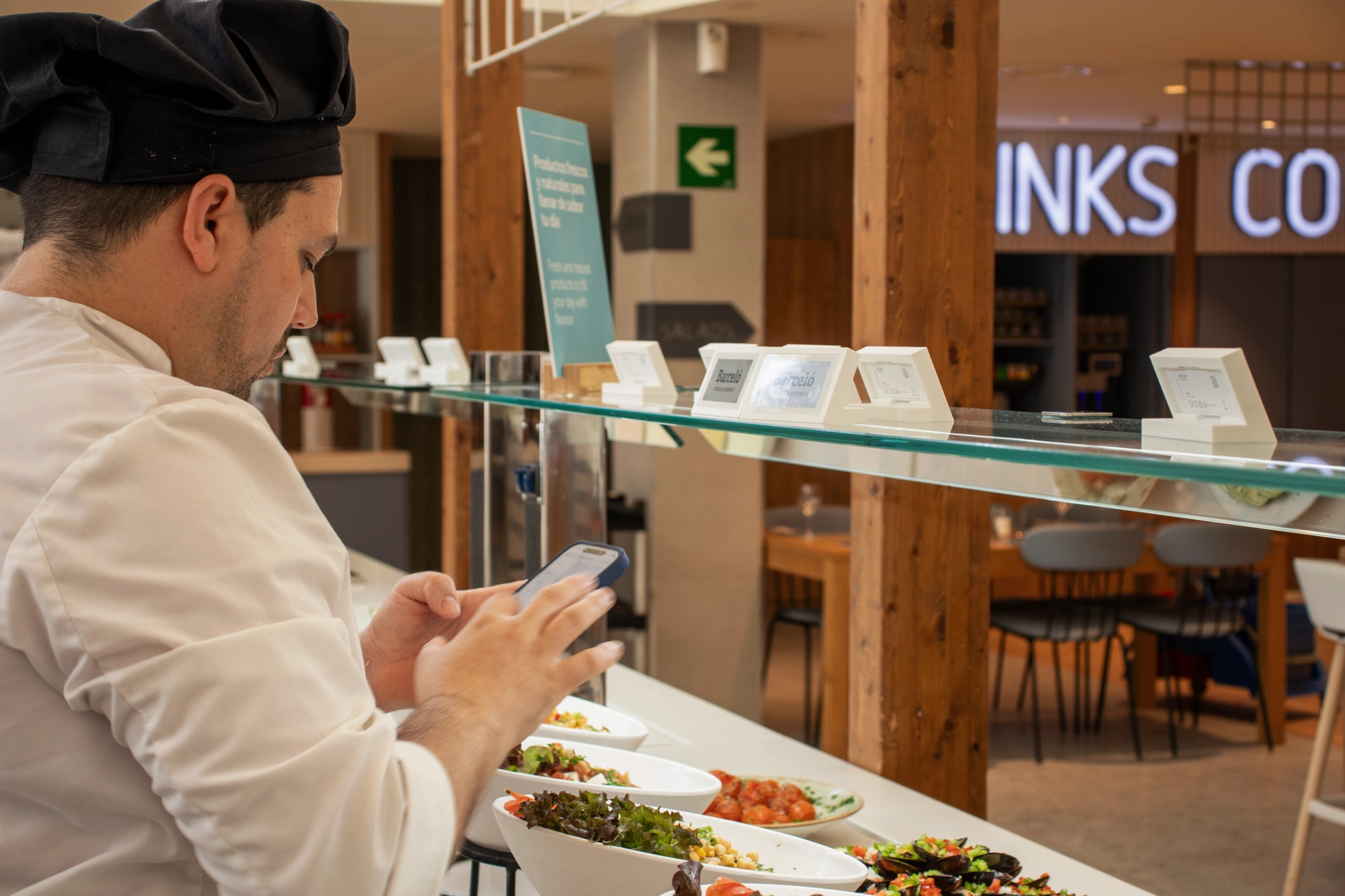
The maintenance of electronic labels in hotel buffets is far lower than most teams imagine. Although it requires an initial investment, their long lifespan, resistance and minimal need for intervention mean that digitalising the buffet pays for itself in less than a year. It’s an operational advantage that many F&B teams notice from day one.
The daily challenge of the buffet: small tasks that never disappear
In a hotel buffet, every service brings small tasks that consume time: repositioning labels, correcting recipe changes, updating allergens or replacing signs damaged by steam or constant use. These are not major incidents, but they are repetitive. And in a department as demanding as F&B, every repetition adds up.
When a hotel considers digitalising the buffet, attention usually focuses on aesthetics, agility or sustainability. But there is a key factor that directly impacts the bottom line: maintenance is so minimal that the initial investment is recovered in less than a year.
The hidden cost of manual labelling
Although not always reflected in budgets, maintaining manual signage requires constant dedication. Every change demands printing, laminating, placing and reviewing. If a recipe changes or there is an allergen mistake, the process starts again.
On top of the time required, there is a continuous consumption of materials and small incidents which, added day after day, affect efficiency and operational costs.
The turning point: a solution that barely requires maintenance
Digital labelling brings agility, order and accuracy, but its most decisive advantage is this: it requires minimal maintenance. And that simple reality accelerates the return on investment.
In practice, reducing buffet electronic label maintenance has a direct effect on daily operations and the stability of the service.
1. Labels do not need repositioning from service to service
Each label is linked to its dish and its position on the buffet. They don’t disappear, get mixed up or need to be reorganised before opening. This “automatic order” reduces one of the most repetitive tasks of the day.
2. Menus are updated automatically from the cloud
A recipe change, a new dish or an allergen adjustment is instantly reflected on all labels. There is no need to print or laminate anything. The update is made from the software, and the labels sync automatically.
3. Labels designed to withstand real buffet conditions
Electronic labels are built to resist high temperatures, steam, grease, frequent cleaning, drops and constant handling. They do not require special care or frequent replacements. They simply work.
4. Real autonomy: up to 7 years with no recharging
One of their biggest advantages is their long-lasting battery. With up to seven years of autonomy, they eliminate recharging tasks and periodic maintenance entirely. This provides stability and reduces the team’s workload even further.
5. Fewer materials, fewer incidents, fewer reprocesses
Digitalising the buffet means forgetting about paper, ink, laminating and disposable supports. It also eliminates recurring errors caused by outdated signs or last-minute changes. All this simplifies operations and reduces costs directly.
Together, this low buffet electronic label maintenance becomes one of the strongest arguments for digitalising a buffet.
The impact on the bottom line
When you remove repetitive tasks, material consumption and daily small incidents, the result is clear: the initial investment pays for itself very quickly.
This is not an optimistic projection. It is the natural result of replacing manual processes with a system that stops generating work and starts preventing costs. That is why, in most hotels, the return arrives before the first year.
Beyond ROI: stability and an improved guest experience
Reducing maintenance is not only an economic benefit. It also improves the guest experience and operational stability. A buffet that stays organised without constant supervision conveys professionalism and reduces stress for the team.
Fewer checks, fewer errors and more time for service: that is the real difference the guest notices.
Conclusion
Digital labelling for hotel buffets requires an initial investment, yes. But minimal maintenance and the cumulative reduction of tasks and materials mean that the payback period is very short. Meanwhile, the buffet gains efficiency, accuracy and professionalism.
Digitalising is not only about innovating: it is about simplifying operations, freeing the team and improving the hotel’s profitability sustainably.